


 By
By self-care is not primarily about comfort rituals. Sustainable well-being requires structural interventions—especially therapy—that address cognitive patterns, attachment dynamics, and behavioral cycles.
Most people searching this phrase are asking a simple question: Is therapy “real” self-care, or is that just a dramatic rebrand?
Therapy is foundational self-care because it changes the patterns that create stress, not just the symptoms.
Self-care has been reduced to aesthetics—bath bombs, skincare routines, Sunday resets. The agitation comes later: you relax, reset, and two weeks later, you are overwhelmed again. Same conflict. Same burnout. And Same anxiety spike.
The solution is not to abandon comfort rituals. It’s to put them in the right order. Regulation matters. But reconstruction matters more. If your stress is recurring, self-care that only soothes is maintenance — not repair.
Is Self-Care More Than Bubble Baths? – The Core Pillars of True Self-Care
People often equate self-care with things that feel good or look good on social media. That’s the “aesthetic self-care” mindset. But true self-care is deeper. It targets patterns, not symptoms. It improves your capacity to show up, not just your immediate mood. This distinction is powerfully explored in Real Self-Care: A Transformative Program for Redefining Wellness by Pooja Lakshmin, which challenges the idea that wellness is about indulgence and instead reframes it as structural, values-driven change.
Boring vs. Aesthetic Self-Care
Bubble baths are soothing — but they rarely shift emotional patterns in a lasting way. True self-care tackles why the stress keeps returning.
| Category | Example Activities | Typical Outcome | Level of Change |
| Aesthetic Self-Care | Bubble baths, candles, spa day, skincare rituals | Temporary relief | State regulation |
| Boring Self-Care | Sleep hygiene, hydration, boundaries | Improved daily stability | Foundational habits |
| Structural Self-Care | Therapy, cognitive work, exposure, and boundary therapy | Reduced cyclical stress | Pattern reconstruction |
Why Therapy Is Self-Care
Therapy is not a spa day — it’s targeted work to understand and change internal patterns:
- It helps identify cognitive distortions.
- It builds emotional regulation skills.
- It alters attachment dynamics.
- It addresses avoidance behavior.
These aren’t temporary fixes — they change how your nervous system responds over time.
Multiple high-authority organizations recognize therapy’s efficacy for mental health:
- The American Psychological Association describes structured therapy as a primary evidence-based intervention for many emotional challenges.
- The National Institute of Mental Health identifies therapy modalities like CBT and ACT as effective treatments.
- The World Health Organization advocates for early mental health intervention as part of preventative care.
Relaxation reduces current tension. Therapy reduces the frequency and intensity of future distress.
How Therapy Works?
To see why therapy counts as core self-care, let’s break down what it actually does:
What Therapy Changes vs. What Rituals Change
| Outcome | Bubble Baths & Rituals | Therapy |
| Mood regulation | Yes (short-term) | Yes (with skills that generalize) |
| Behavioral change | No | Yes |
| Cognitive restructuring | No | Yes |
| Attachment pattern change | No | Yes (over time) |
| Avoidance reduction | No | Yes |
| Prevent relapse | Minimal | Strong |
Therapy addresses both structure and process — not just temporary relief.
Where Is Therapy Available?
Therapy isn’t a single service. It varies by format, specialization, and location. TherapyKaro and Better Self are examples of platforms that serve users in India with both psychologists and psychiatrists via video, phone, or messaging — often in regional languages with flexible scheduling.
| Format | Typical Locations |
| In-Person Clinics | Urban and metro centers (Delhi, Mumbai, Hyderabad, Bangalore, Chennai in India; New York, London, Vancouver globally) |
| Online Platforms | Worldwide via apps / web |
| Mobile Apps | Smartphone accessibility globally |
| Nonprofit Networks | Discounted therapy networks (e.g., Open Path Collective in the U.S.) |
Therapy Prices and Packages
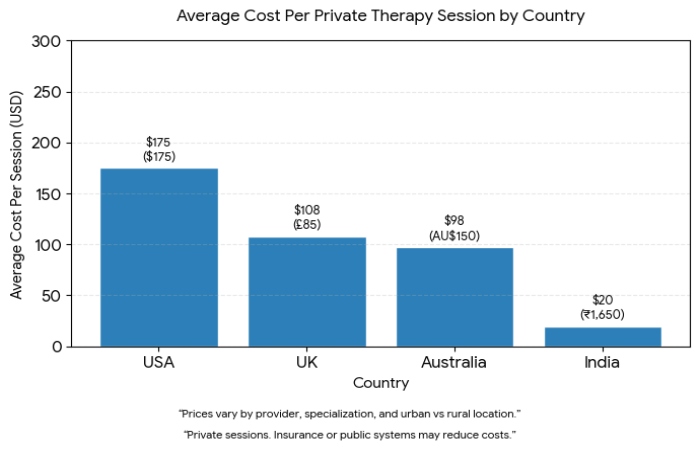
The therapy costs vary based on professional qualifications, level of specialization, delivery format (online vs in-person), session length, and geographic region. Pricing may also differ depending on whether you choose private practice, clinic-based care, or app-based platforms, as well as whether insurance or public healthcare systems are involved.
Therapy Costs in India
| Provider / Package | Price Range | Notes |
| Single Session (Private) | ₹800 – ₹3,500 | Depends on therapist’s experience |
| 4-Session Package | ₹3,000 – ₹7,000 | Short-term support |
| Online Platform Bundles (Better Self) | ₹999 – ₹1,999 per session | Certified professionals |
| Subscription Models | ₹4,000 – ₹11,500/month | Weekly check-ins, messaging support |
| Student/Discount Packages | ₹500 – ₹1,200 | Affordable tiers for youth |
Global Online Therapy Platforms and Cost
Prices vary significantly by region. In the U.S., traditional face-to-face therapy often costs $125–$200+ per session out-of-pocket. Online options are usually less expensive, albeit not always covered by insurance.
| Platform | Cost | Notes |
| BetterHelp | $65 – $100/week | Flexible scheduling, no insurance required |
| Talkspace | $69 – $109+/week | Insurance coverage possible, includes some psychiatry |
| 7 Cups | Free to low-cost | Peer support + volunteer listeners |
| Regain | ~$70 – $100/week | Couples & relationship focus |
Apps & Platforms for Therapy
Online platforms make therapy more accessible — but features and quality vary. Apps can be great starting points, especially for people who are curious but unsure where to begin. However, these should complement — not replace — trained therapist work when deep psychological change is the goal.
| Platform | Best For | Formats |
| BetterHelp | Flexible online therapy | Video, phone, messaging |
| Talkspace | Insurance coverage & psychiatry | Messaging, video |
| 7 Cups | Emotional support & listening | Text chat |
| InnerHour (Amaha) | App-based structured plans | CBT, assessments, tools |
| TherapyKaro / Better Self | Local / India-focused | Regional language support |
Side Effects & Risks of Therapy
Therapy is generally safe when provided by licensed professionals, but experiences vary:
- Emotional discomfort: Growth requires addressing past or current stressors.
- Therapist mismatch: Early sessions can feel unhelpful if the fit isn’t right — switching is normal.
- Slow progress: Meaningful change often takes weeks or months.
- Cost & accessibility barriers: Can limit consistent engagement.
- Quality variance: Not every therapist is the right match.
This realistic framing matters — therapy isn’t instant relief but structured work.
Real Self-Care vs Faux Self-Care (Bubble Baths)
Faux self-care feels good but isn’t designed to change why the stress loops keep repeating.
| Element | Faux Self-Care | Real Self-Care |
| Main Focus | Relief | Structural change |
| Typical Activities | Baths, spa, treats | Therapy, boundary work |
| Time Investment | One-off, episodic | Regular commitments |
| Emotional Payoff | Quick relief | Enduring resilience |
| Risk of Avoidance | High | Low |
| Short-Term Change | Yes | Yes |
| Long-Term Transformation | No | Yes |
Comparisons with Others
Therapy remains unique because it combines personalization, accountability, evidence-based methods, and measurable outcomes.
| Option | Best For | Limitations |
| Bubble Baths | Short-term mood lift | Doesn’t change patterns |
| Journaling | Greater self-reflection | No external perspective |
| Meditation Apps | Relaxation | No personal feedback |
| Therapy | Long-term emotional restructuring | Time & financial investment |
| Peer Support | Emotional validation | Limited skill development |
FAQs
Q: Is therapy worth it?
A: For chronic stress, anxiety, relationship issues, or repeated burnout cycles, therapy often delivers lasting change whereas temporary rituals do not.
Q: Can I start therapy online?
A: Yes. Many platforms like BetterHelp, Talkspace, TherapyKaro, and InnerHour offer online formats. Costs vary by package and location.
Q: How long does therapy take?
A: Many start with weekly sessions over 8–12 weeks — but this varies based on goals.
Q: Are there free or affordable options?
A: Some platforms offer sliding scales, group sessions, or peer support (e.g., 7 Cups). Nonprofit networks like Open Path Collective offer significantly discounted therapy in the U.S.
Q: Are apps as effective as traditional therapy?
A: Apps increase access and convenience, but they’re best viewed as complements to real therapeutic work for deeper issues.
Conclusion – Structure First, Comfort Second
Self-care that prioritizes comfort over change is incomplete. Bubble baths are maintenance; therapy is structural maintenance.
One soothes the nervous system.
The other reshapes the system itself.
If your stress is recurring, if your burnout is cyclical, if your relationships repeat the same pattern — the answer becomes clear: Self-care starts with therapy — because long-term resilience is built on understanding and changing patterns, not just easing symptoms.
