

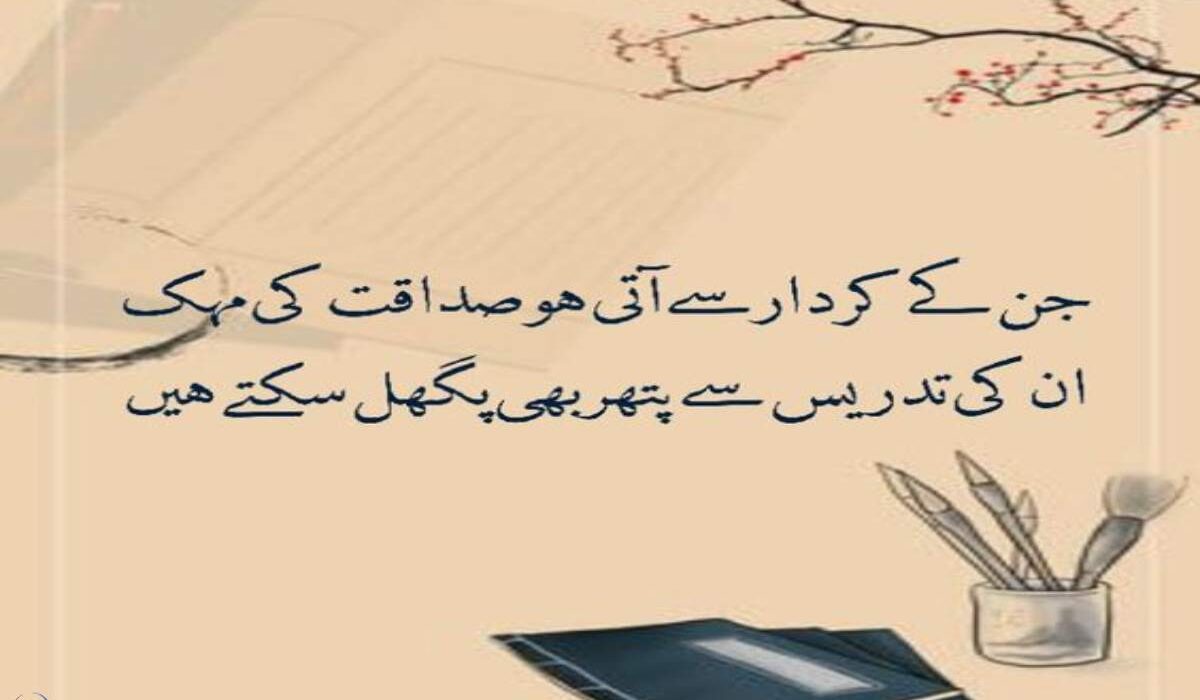
In the rich tapestry of South Asian culture, the teacher, or Ustaad, occupies a position of profound reverence, often placed alongside parents in the hierarchy of respect. Honoring them is not merely a gesture of thanks but a deeply ingrained social and moral tradition known as “Ustaad ka aitraam.” Urdu, with its lyrical grace and unparalleled capacity for expressing nuanced emotion, becomes the natural language for this tribute. Poetry in Urdu is more than words; it’s an art form that elevates gratitude into something timeless and soul-stirring.
This tradition finds its fullest expression during Teachers’ Day celebrations, farewell ceremonies, and retirement functions, where students and communities use shayari (poetry) to articulate what simple “thank you” cannot capture. This guide delves into this beautiful cultural practice, offering not just a collection of verses but also the context, etiquette, and practical knowledge to use them meaningfully, ensuring your appreciation resonates with the depth it deserves.
How to Choose & Use Poetry: A Practical Guide
Selecting the right verse for the right moment is crucial. A powerful, intense ghazal might overwhelm a small card, while a light couplet may not suffice for a formal farewell speech. Use this guide to match the poetry to your occasion.
1. For a Handwritten Card or Personal Note:
- Type: Choose a short, heartfelt couplet (sher) or a single, impactful line.
- Focus: Personal gratitude. Select a verse that reflects what the teacher specifically meant to you.
- Delivery: Write the Urdu script neatly, followed by a clear Roman transliteration and a brief English translation if needed. Add a personal note explaining why you chose that line.
2. For a Speech or Public Address (Teachers’ Day/Farewell):
- Type: Opt for a slightly longer excerpt (2-4 couplets) from a renowned poet. Begin or end your speech with it.
- Focus: Universal themes of guidance, sacrifice, and legacy. Ensure the flow of your speech leads naturally into and out of the poetry.
- Delivery: Practice pronunciation. Recite slowly, with feeling and appropriate pauses. You may wish to provide printed copies or a slideshow with the text for the audience.
3. For a Social Media Tribute (Instagram, Facebook):
- Type: A visually appealing graphic (shayari post) featuring a single, poignant couplet.
- Focus: Shareable and aesthetically pleasing. Use elegant fonts and complementary backgrounds.
- Delivery: Pair the image with a caption telling a brief story about the teacher. Use relevant hashtags such as #UrduPoetry, #TeacherAppreciation, and #ShukriyaUstaad.
4. For a Gift Inscription or Plaque:
- Type: A timeless, classic couplet about knowledge and light. It should be concise and profound.
- Focus: Permanence and elegance. The verse should stand alone without the need for explanation.
- Delivery: Ensure the engraving or printing is flawless. Present the gift alongside a verbal or written personal message.
Hand-Selected Poetry Library with Context
Here is a categorized selection of Urdu poetry for teachers, complete with context for meaningful use.
| Occasion / Theme | Urdu Text (نستعلیق) | Roman Transliteration | English Translation / Sentiment | Suggested Use |
|---|---|---|---|---|
| General Respect & Legacy | استاد کی عظمت کو ترازو میں تولنا استاد ایک بے مثال تحفہ ہے |
Ustaad ki azmat ko tarazu mein tolnā Ustaad ek be-misaal tohfa hai. |
To weigh a teacher’s greatness on any scale / A teacher is an incomparable gift. | Speech opening, gift plaque, social media post. |
| Guidance & Light | وہ قندیل راہ تھے، وہ منزل نہیں تھے ہماری راہوں کو انہوں نے روشن کیا تھا |
Wo qandeel-e-raah the, wo manzil nahi the Humari raahon ko unhon ne roshan kiya tha. |
They were the lantern on the path, not the destination / They illuminated our paths for us. | Farewell speech, reflective tribute. |
| Impact & Transformation | الفاظ نہیں، اصول سکھائے تھے آپ نے کتابیں نہیں، کتابِ زندگی پڑھائی تھی |
Alfaaz nahi, usool sikhaye the aap ne Kitaabein nahi, kitaab-e-zindagi padhai thi. |
You taught not just words, but principles / You taught not just books, but the book of life. | Personal note, retirement tribute. |
| Simple & Heartfelt (For Cards) | شکر ہے اُس استاد کا، جس نے مجھ کو میں سے آشنا کیا |
Shukr hai us ustaad ka, jis ne Mujh ko “mein” se aashna kiya. |
Grateful for that teacher who / Introduced me to my own “self.” | Handwritten card, short message. |
| Teachers’ Day Specific | یہ علم کا چراغ، یہ فکر کا سفر سب آپ کا احسان ہے، اے میرے استاد یوم اساتذہ مبارک |
Ye ilm ka chiraagh, ye fikr ka safar Sab aap ka ahsaan hai, aye mere ustaad Youm-e-Asatizah Mubarak! |
This lamp of knowledge, this journey of thought / All is your blessing, O my teacher. Happy Teachers’ Day! | Teachers’ Day cards, events, social media. |
Beyond Poetry: Other Ways to Appreciate Teachers
While poetry is a powerful medium, pairing it with other heartfelt gestures creates an unforgettable tribute.
- The Personal Letter: Write a sincere letter in Urdu or your shared language. Describe a specific moment when their guidance changed your perspective. Frame the letter with a couplet from the library above.
- A Video Tribute: Collaborate with classmates to create a short video. Each person can recite a different couplet of a longer poem, sharing what the teacher meant to them. This is perfect for a farewell or retirement.
- A “Wisdom Journal” Gift: Present a beautiful notebook. On the first page, inscribe a piece of Urdu poetry. Encourage the teacher to use it, or ask past students to fill it with their favorite lessons and memories.
- Curated Gift Pairing: Pair a poetry book by a legendary poet like Allama Iqbal (who wrote extensively on knowledge) with a bookmark featuring your chosen couplet. It connects the gift directly to the sentiment of your thanks.
FAQs on Urdu Teacher Poetry
Q: What are some simple Urdu couplets I can write in a teacher’s card?
A: The couplet under “Simple & Heartfelt” in the table above is perfect. Another is: “Aap ki mehnat ka hai yeh phool, / Humein banaya aap ne jism-o-jaan se.” (This flower is from your labor, / You shaped us with your heart and soul.)
Q: How do I pronounce Urdu poetry correctly if I’m not a native speaker?
A: Focus on the Roman transliteration. Practice slowly, listening to online recitations on YouTube. Break words into syllables. Most teachers will deeply appreciate the sincere effort, even if the pronunciation isn’t perfect.
Q: Can I use this poetry in a school magazine or newsletter?
A: Absolutely. It is highly encouraged. Always credit the poet if known. For anonymous or traditional verses, you can write “Traditional Urdu Couplet.” Our curated table is designed for you to use and share with attribution.
Q: Where can I find more Urdu poetry for teachers?
A: Explore the works of poets who wrote on knowledge and mentorship: Allama Iqbal (especially Bang-e-Dra), Mirza Ghalib, and Ahmed Faraz. Searching for “shukriya ustaad shayari” or “ustaat par shayari” will yield many results.
Conclusion: The Sincerity of Your Voice
While the poetry provided here is a beautiful tool, the most profound tribute lies in your personal voice. Use these verses as a foundation, as inspiration to articulate your own feelings. Perhaps a line will spark a memory that leads you to write your own few sentences of thanks. In the end, whether you recite a masterpiece by Iqbal or speak a few simple, shaky words from the heart, it is the sincerity of your gratitude that will touch your teacher’s soul. For they, more than anyone, understand that true learning is not just in the words recited, but in the genuine sentiment behind them.