

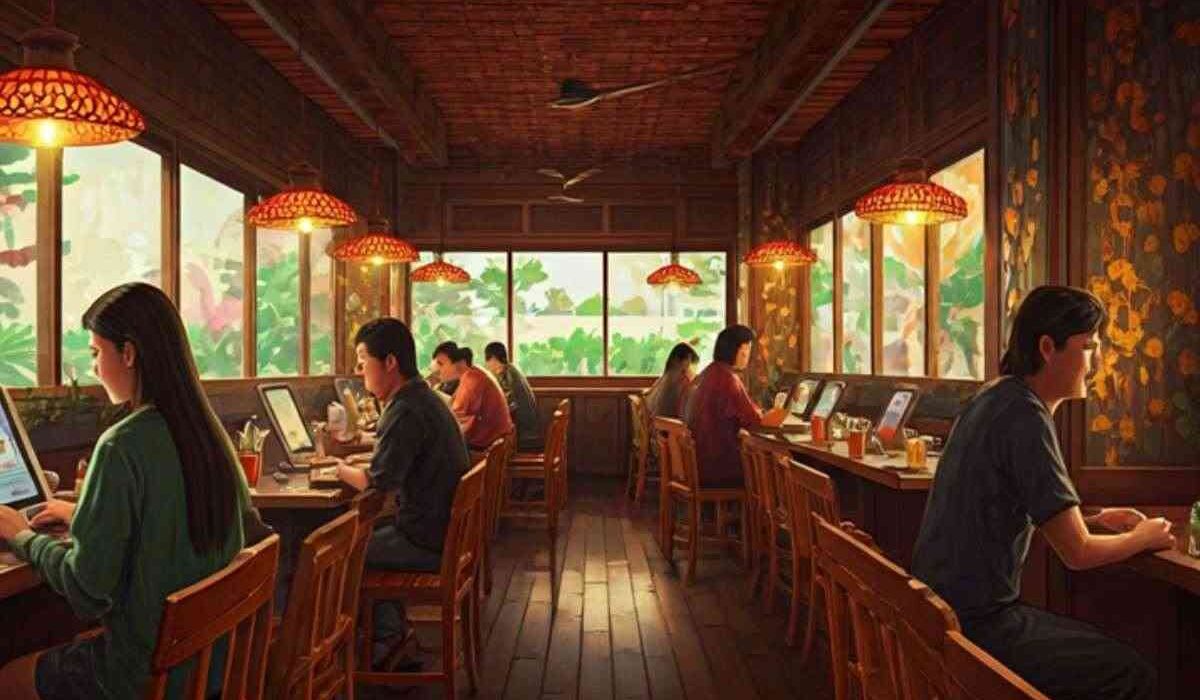
Thailand’s busy food spots now use self ordering systems more and more. You can find these tools in cafes, convenience stores, and other places to eat. They let you pick and pay for food on your own through mobile applications and smart phones. To order, you can use kiosks, tablets, or even QR codes on your phone. This self ordering system makes everything faster and easier for people. It also cuts down on mistakes with orders. Many big and small places are starting to use these self ordering and QR code methods, making eating out better all over Thailand.
Thailand is no longer “experimenting” with self ordering systems—it’s institutionalizing them across restaurants, cafés, food courts, and even retail.
The reason is not hype. It is economics.
- Labor shortages in hospitality
- Rising wage pressure
- High smartphone penetration
- Strong adoption of QR payments (PromptPay ecosystem)
According to industry data, Thailand’s restaurant POS ecosystem has rapidly evolved into cloud-based, mobile-first systems with QR code ordering integration.
If your business in Thailand still relies entirely on manual ordering, you are not competing on efficiency—you are absorbing unnecessary cost.
What Is a Self Ordering System?
A self-ordering system allows customers to browse, select, and place orders without staff interaction using digital interfaces.
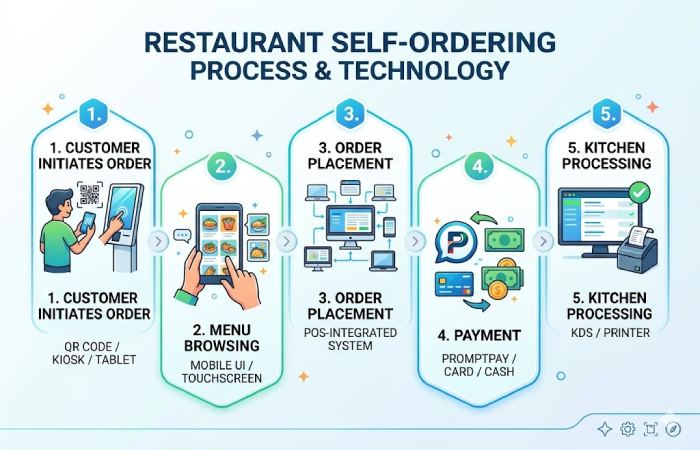
Types of Self-Ordering Systems in Thailand
1. QR Code Ordering
QR ordering is the most widely used format because it aligns perfectly with Thailand’s mobile-first culture.
| Feature | Benefit |
| No hardware required | Lower upfront cost |
| Works on customer phones | High adoption rate |
| Integrates with PromptPay | Faster checkout |
| Easy menu updates | No printing cost |
Systems like Qashier enable QR ordering with POS integration and start at low monthly pricing tiers.
2. Self-Service Kiosks
Kiosks are used where speed and volume matter more than personalization.
| Use Case | Typical Business |
| Fast food chains | McDonald’s-type outlets |
| Food courts | Shopping malls |
| High-traffic QSR | Urban Bangkok |
3. Tablet Ordering
| Feature | Advantage |
| Fixed device | Controlled experience |
| Visual menus | Better upselling |
| Multi-language support | Tourist-friendly |
Key Features & Specifications
| Feature | Description | Importance Level |
| POS Integration | Sync orders with billing & kitchen | Critical |
| QR Ordering | Mobile-based ordering | Critical |
| Payment Integration | PromptPay, cards | Critical |
| Multi-language UI | Thai + English | High |
| KDS (Kitchen Display) | Real-time order tracking | High |
| Inventory Management | Auto stock updates | Medium |
| CRM & Loyalty | Customer tracking | Medium |
Modern systems like GPOS and eG-POS integrate QR ordering, CRM, and real-time analytics into a single platform.
Prices in Thailand
| System Type | Price Range (THB) | Notes |
| QR Ordering SaaS | ฿0 – ฿199/month | Entry-level systems available |
| POS + QR bundle | ฿1,500 – ฿3,000/month | Most common tier |
| Advanced cloud POS | ฿3,000+/month | Includes analytics & multi-branch |
| Kiosk hardware | ฿50,000 – ฿150,000/unit | One-time cost |
| Tablet setup | ฿5,000 – ฿20,000 | Depends on hardware |
Example:
- Qashier QR ordering starts around ฿199/month
- eG-POS offers plans from ฿0 to ฿3,000/month
- BOXS POS starts from ฿1,500/month
Thailand Providers
| Provider | Best For | Key Feature |
| Qashier Thailand | Small–mid restaurants | QR ordering + POS |
| eG-POS | Scalable businesses | Multi-branch cloud POS |
| BOXS POS | Multi-store operations | QR ordering + AWS cloud |
| GPOS | All-in-one solution | CRM + QR + delivery |
| TTPOS | Smart automation | AI-driven ordering |
These providers offer direct demos, onboarding, and localized support in Thailand.
Self-Ordering vs. Traditional System
| Factor | Self Ordering | Traditional |
| Speed | High | Medium |
| Labor Cost | Low | High |
| Accuracy | High | Medium |
| Customer Interaction | Low | High |
| Upselling | Automated | Manual |
| Data Collection | Strong | Weak |
Alternatives to Self-Ordering Systems
| Alternative | Description | When to Use |
| Digital Menu Only | QR menu without ordering | Low budget |
| POS-only system | Staff takes order digitally | Small restaurants |
| Hybrid model | Staff + QR ordering | Best balance |
| Mobile ordering app | App-based ordering | Chain brands |
Pros and Cons
Advantages
| Pros | Impact |
| Reduced staff cost | Lower operating expenses |
| Faster service | Higher turnover |
| Increased order value | Better upselling |
| Data tracking | Smarter decisions |
| Fewer errors | Better accuracy |
Disadvantages
| Cons | Risk |
| Poor UX can hurt sales | Revenue loss |
| Customer resistance | Especially older users |
| Setup complexity | Training required |
| Subscription costs | Long-term expense |
Real User Reviews
Insights from user discussions:
“A good QR menu system is amazing. A bad one is frustrating.”
“Convenient… especially with language barriers.”
“Browsing on a small screen is not comparable to a menu.”
- UX quality determines success more than the technology itself
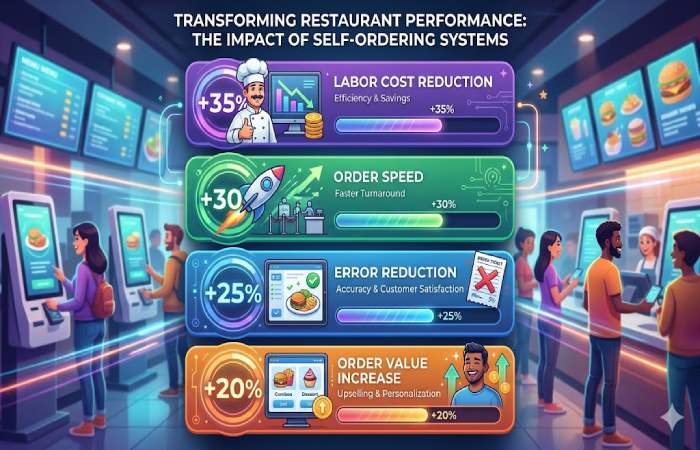
ROI Analysis: When It Makes Sense
| Metric | Improvement |
| Order Value | +10–25% |
| Labor Cost | -20–40% |
| Order Speed | +30% |
| Error Reduction | +20–30% |
Implementation Checklist
| Step | Action |
| 1 | Choose provider |
| 2 | Upload menu |
| 3 | Configure payment |
| 4 | Train staff |
| 5 | Test system |
| 6 | Launch |
Final Verdict
Self-ordering systems in Thailand are not just tools—they are profit-optimization engines.
- Small businesses use them to survive rising costs
- Large chains use them to scale efficiently
- Smart operators use them to capture data and increase margins
The biggest mistake is not adopting self ordering. The second biggest mistake is adopting it poorly.
FAQs
What is the best self ordering system in Thailand?
There is no single “best.” Qashier is good for small businesses, while eG-POS suits scaling operations.
How much does a self ordering system cost in Thailand?
It ranges from free to ฿3,000/month, depending on features.
Is QR ordering popular in Thailand?
Yes, it is the dominant format due to mobile-first behavior and PromptPay adoption.
Do customers like self ordering systems?
Mixed response—young users prefer it, while older customers may resist.
Can small restaurants use it?
Yes, many systems offer free or low-cost entry plans.