

 By
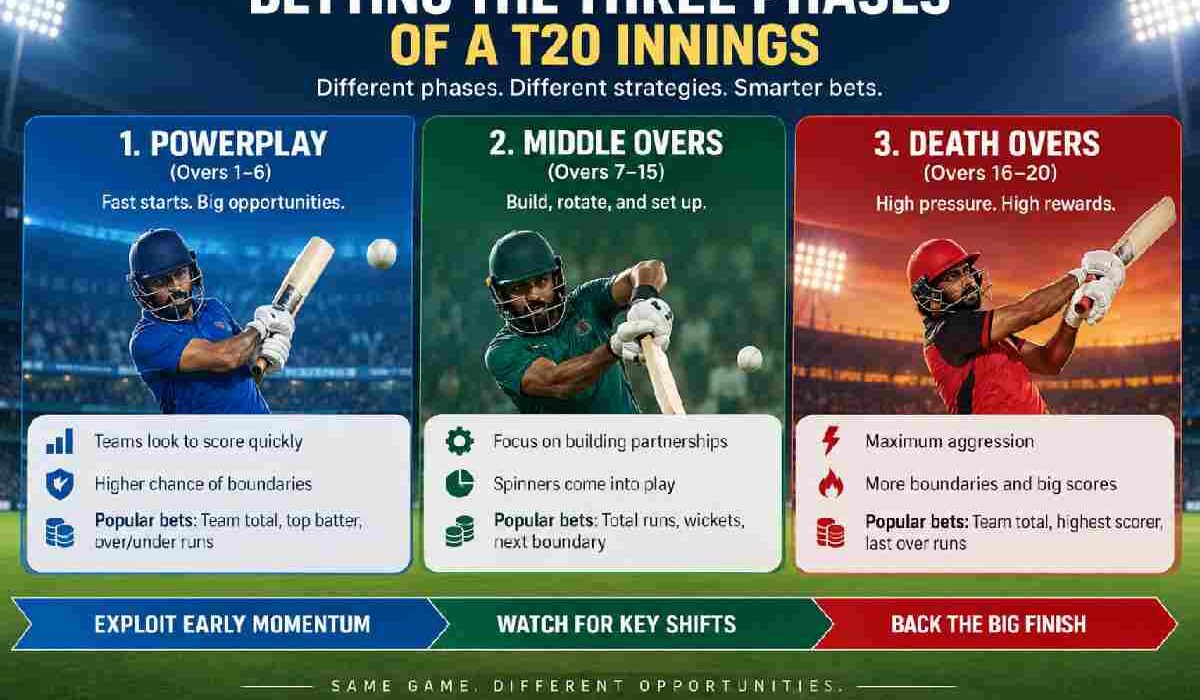
By Betting the Three Phases of a T20 Innings
Most people watch a T20 innings as one continuous twenty-over event. Players and coaches do not. They think of it as three distinct passages of play — the powerplay, the middle overs and the death — each with its own rules, its own tactics and its own scoring pattern. The teams that win consistently are the ones that plan for each phase separately, and bettors who follow the same logic tend to read markets far more accurately than those who treat the innings as a single block.
This guide breaks down what actually happens in each phase, why the market often prices them less carefully than it prices the match result, and how to form a view on a specific phase rather than on the whole game.
Why Phases Matter More Than the Total
A final total of 180 can be built in completely different ways. One side might race to 65 in the powerplay, stall through the middle and scrape to 180. Another might be 38 after six overs, rebuild patiently, and then take 70 from the final five. The number on the scoreboard is identical; the story underneath it is not.
That matters because many markets are tied to specific phases rather than to the innings as a whole — powerplay runs, runs in a block of overs, wickets in a given period. Each of those is a question about one phase, and answering it well requires thinking about that phase specifically rather than about how good the batting side is in general.
It also matters for match-result betting in play. The price at the end of the powerplay reflects what happened in those six overs, but it does not always reflect what the batting and bowling resources available for the rest of the innings imply. That gap is where phase-level thinking earns its keep.
The Powerplay: Overs One to Six
During the powerplay only two fielders are allowed outside the inner circle, which is why this is the phase where boundaries come most easily. Batting sides want to use it aggressively; bowling sides want early wickets with the new ball while it still offers swing or seam.
The key variables are the openers and the surface. An aggressive opening pair on a flat pitch can put the powerplay beyond reach quickly. The same pair against a new ball that is moving, or on a surface with uneven bounce, can lose two wickets in the first three overs and change the whole innings. Conditions in the first half hour matter more here than at any other point in the match.
A useful habit is to separate the question of how many runs the powerplay will produce from how many wickets it will cost. The two are linked but not identical, and the market sometimes prices the runs sensibly while underestimating the damage an early collapse does to everything that follows.
The Middle Overs: Seven to Fifteen
Once the fielding restrictions end, the game changes character. Fielders spread to the boundary, spinners typically take over, and scoring shifts from boundaries to rotation of the strike. This is the phase casual viewers find least exciting and the one where matches are most often quietly decided.
The middle overs reward sides with batters who can manipulate the field and bowlers who can hold down an end. A team that loses wickets here often has to rebuild when it should be accelerating, while a team that keeps wickets in hand through this phase gives itself the resources for a big finish.
From a betting perspective, the middle overs are where spin becomes decisive. If a surface is gripping, or if one side has noticeably better spinners, the gap between the teams opens up here. Over-window markets covering this period often reward a careful read of the spin matchup more than any other factor.
The Death Overs: Sixteen to Twenty
The final five overs are where the largest scoring swings occur. Batters take maximum risk, bowlers rely on yorkers, slower balls and variations, and a single over can go for twenty runs or cost two wickets. The quality of a side’s death bowling is one of the most important and most underrated factors in T20 cricket.
Two things dominate this phase. The first is wickets in hand — a side entering the death with seven wickets remaining can swing hard with little concern, while a side with three left must be more careful. The second is who is left to bowl. A captain who has used his best death bowlers early may be forced to finish with part-time options, and that is visible on the scorecard several overs before it happens.
Death-over markets are volatile, which makes them attractive and dangerous in equal measure. A strong read on the bowling resources remaining is genuinely valuable here; a feeling that a big finish is coming is not.
None of this requires a special type of account. Phase markets sit alongside match markets on most exchange platforms, so whichever cricket ID you hold, the tools are the same. What differs is whether you use them with a specific view on a specific phase or place bets on the innings as a whole without thinking about how it will be built.
How Conditions Change Each Phase
The same surface can play very differently across an innings. A pitch with early movement makes the powerplay harder and the middle overs easier once the ball softens. A slow, gripping surface does the opposite — the powerplay can be productive while the new ball comes on, and the middle overs become a grind against spin.
Evening matches add dew, which tends to make the death overs easier for the batting side as the ball becomes wet and difficult for bowlers to grip. That effect is strongest in the second innings, which is why chasing sides often find the final phase more comfortable than the target suggests.
Reading how conditions interact with each phase is more useful than reading conditions in general. A pitch report that says the surface is good for batting tells you little on its own; knowing when in the innings it will be good for batting tells you much more.
Common Mistakes With Phase Markets
The first is overreacting to the powerplay. A quick start creates an impression of dominance that the rest of the innings does not always support, especially if wickets have fallen. Equally, a slow start with no wickets lost often precedes a strong finish, and the market can be too pessimistic about it.
The second is ignoring bowling resources. Many bettors track the batting side closely and pay little attention to which bowlers have overs left. That is backwards for the death overs, where the bowling plan often decides the outcome more than the batting does.
The third is treating phases as independent. They are not. Wickets lost in the powerplay change middle-over tactics; a slow middle phase raises the pressure at the death. Good phase betting keeps the whole innings in mind while making a judgement about one part of it.
Using Phase Thinking in Live Betting
Phase awareness is most useful during a match rather than before it. At the end of the powerplay, the natural question is whether the price for the match now reflects what the rest of the innings is likely to hold. That depends on wickets in hand, who is still to bat, and which bowlers have overs left for the middle and the death.
A side at 50 for 0 after six overs with a strong finisher still to come and weak death bowling facing them is in a very different position from a side at 50 for 0 facing the best death attack in the competition. The scoreboard is identical; the outlook is not. Live prices do not always make that distinction carefully, especially in the minutes straight after a fast start.
The habit worth building is to pause at each phase boundary — after the sixth over and after the fifteenth — and ask what has changed in terms of resources rather than runs. That short check is often enough to separate a considered bet from a reaction to the last few overs.
Frequently Asked Questions
What are the three phases of a T20 innings? The powerplay (overs one to six, with fielding restrictions), the middle overs (seven to fifteen, usually dominated by spin and strike rotation) and the death overs (sixteen to twenty, where batters take maximum risk).
Which phase is most important? It varies with conditions, but the middle overs quietly decide more matches than people think, and the quality of death bowling is one of the most underrated factors in T20 cricket.
Why do powerplay scores mislead? Because a fast start with wickets lost can leave a side short of resources later, while a slow start with wickets in hand often sets up a strong finish. The runs tell only part of the story.
How does dew affect the phases? It usually makes the death overs easier for the batting side, particularly in the second innings, because a wet ball is harder for bowlers to grip and control.
Do I need a different account to bet on phases? No. Phase and over-window markets are generally available alongside match markets on standard exchange accounts.
A Note on Responsible Play
Phase markets move quickly and offer many opportunities within a single match, which makes it easy to place more bets than you intended. Decide in advance how many bets you will place in a match and at what stake, treat betting as entertainment rather than income, and never chase a loss. Use the deposit limits reputable platforms provide. Betting rules differ from state to state in India and continue to change, so check the current position where you live, and only bet if you are of legal age.
